

The first time I tasted durian, I was living in Bali and I wanted to understand what all the fuss was about. So, I picked some up at the nearby Coco Supermarket, ready to be blown away. Instead, I gagged and choked, unable to swallow even a single offensive mouthful. Most first time durian eaters will know what I mean.
But over time, something strange happened. Each day as I rode my scooter from Ubud’s downtown core out to my home in a village outside of town, the smell of durian filled the air. At first it was nauseating, and I would think approvingly of Singapore’s famous durian bans in public spaces. But bit by bit, the stench became a scent, and I became curious.
On one ride home, I spotted a handful of durians piled onto a table — more like a kitchen counter display than a true roadside stand. I quickly pulled over and had my first real taste of durian, fresh from someone’s tree. I was transported, and I became obsessed. I started going on weekend adventures — just me and my scooter, hunting down backyard durians that people set out on makeshift roadside displays all throughout durian season.
I didn’t always know how to ride one but once I learned, my scooter changed my life. It widened my independent radius, introduced me to my neighbors, and made me into one of those people who plans durian vacations.
That’s only the beginning of what mobility can do for a person, and where this intersects with climate is what we’ll get into today.
This transformative climate technology isn’t glamorous
It’s actually pretty dorky, and you won’t look cool using it because you’ll need to wear one of these:

According to recent modeling and analysis by BNEF, electric vehicles are now displacing more than 2.3 million barrels of oil per day. In 2025, 1.1 million barrels were avoided by two and three wheelers, while passenger cars contributed to the avoidance of 741K barrels of oil. The Bloomberg data doesn’t get to ebikes, but we’ll discuss their role later in this essay.
Road transport electrification is outpacing emissions reduction efforts in the industrial, marine and aviation sectors. In fact, the impact of road fleet electrification plus efficiency improvements will displace roughly four times more oil demand by 2040 than efforts across aviation, marine and petrochemicals combined.
Despite this, BNEF actually downgraded their EV outlook due to a slowdown in the Chinese and US markets. But this assessment has a big omission: it’s only looking at cars. In fact, despite their own numbers demonstrating the predominant role of electric two and three wheelers, BNEF’s entire report is dedicated to analysis of the electric car segment.
If you’re reading this from North America or even from Europe, then it’s likely that everything you have ever read about EVs has been about Tesla and BYD, with maybe a couple of mentions of the F150 Lightning, Rivian’s R2 sales, or how inefficient the charmingly un-aerodynamic Volkswagen ID Buzz is.
Instead, the real workhorse of the climate transition is a $1,500 electric scooter zipping around the streets of Jakarta, or a $400 Yadea ebike making deliveries across Shanghai.
Why do we have this blind spot to bikes? It can’t be because fewer people use them. Electric two and three wheelers are the largest segment of road transport globally, with over 80 million units sold annually. But Western energy transition narrative spends 99% of its word count on cars.
To me, this comes down to geography.
The world’s largest EV makers by units shipped aren’t car companies
I learned to ride my first scooter while living in rural India. The first time I attempted to ride, I hit the gas straight into a small retaining wall. I was spooked, but the limits of walking under the hot sun as scooters whizzed past me eventually broke down my fear. I wanted to be the one whizzing past.
In North America, the car is the ultimate symbol of adult independence, status, and economic arrival — like my scooter was for me in Goa. “Bikes,” on the other hand, are toys (and they’re not viewed as VC backable).
Not so in Asia and Africa, where “bikes” — ranging from pedal ebikes to e-mopeds to electric scooters to heavy duty EV motorcycles — are less of a status symbol and more of a necessary tool for earning an income.
The vast majority of those 80 million units are sold in China, India, Southeast Asia, Africa and Latin America. If that sounds like “most of the world, minus North America and Europe,” you’re catching on.
To put some numbers behind it: Yadea, China’s dominant electric two-wheeler manufacturer, sold 11.45 million electric vehicles in 2025. BYD sold 2.26 million. Tesla delivered 1.6 million.
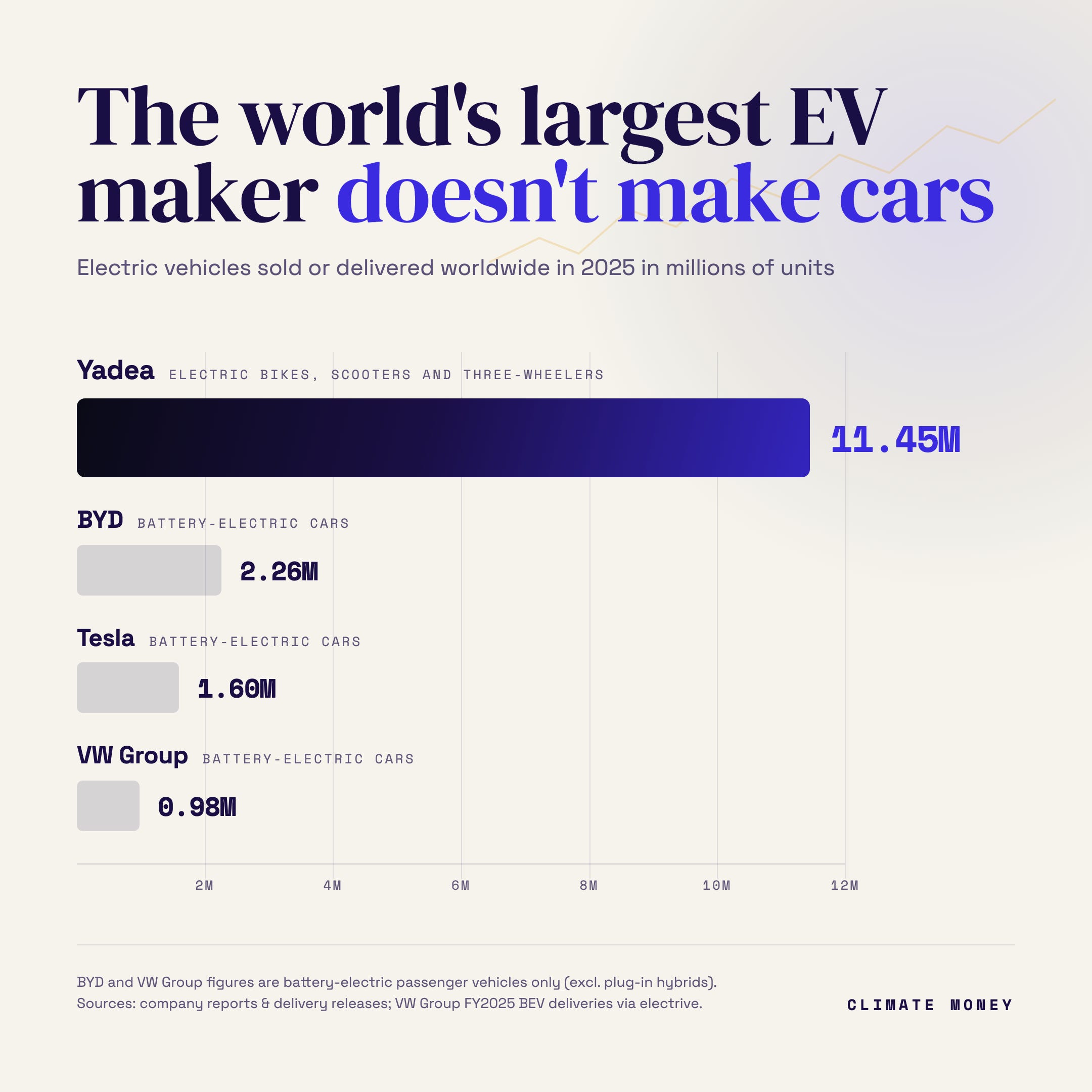
From these numbers, it’s clear why electric two and three wheelers are winning on climate numbers — even though the petroleum-based counterpart they’re displacing already uses far less gas than a car.
So why isn’t BNEF covering them? To their credit, they do somewhat. But BNEF’s institutional clients — global oil majors, legacy OEMs, massive utilities and infrastructure funds — care about passenger EVs because that is the home of both their existential threat and their future capital expenditure. All of this makes sense for Bloomberg, and they do a great job with their coverage overall. But that’s what we have Substack for.
So let’s go a layer deeper, and look at something the climate transition industry rarely likes to discuss.
We need to be talking about ROIB — Return on Invested Battery
My Seattle neighborhood is full of EVs. We have Teslas of course, but also plenty of Rivians, Bolts, ID 4s, a couple of Mercedes EQEs, a Porsche Taycan and even an electric Hummer. This is fun for a carhead like my 4 year old son, but a bit disconcerting to me as an investor who considers myself a climate activist.
Buying a $70,000 EV feels virtuous, but there are important considerations hiding inside that luxurious shell.
ROIB is asymmetric
In venture capital, we often look for capital efficiency. In climate tech, we should be looking much more closely at resource efficiency.
An EV battery pack requires around 8kg of lithium, 40kg of nickel, 10kg of cobalt, 50kg of graphite, and 30kg of manganese, alongside a good amount of aluminum, copper, and steel. The total pack weight of that battery will top out at 400 to 500 kilos for a standard sedan-type car like the Tesla Model S. The Hummer EV’s battery pack weighs an absolutely mindboggling 1,300 kilos — as much as an entire small, gas-powered economy car — and actively accelerates wear and tear on city roads not rated for such gargantuan loads.
It’s a lot of material. So much material that you could build between 120 and up to 400 (!) electric two wheelers with the battery resources needed for one electric truck, depending on whether we’re talking about an ebike (0.5 kWh per battery), an electric Hummer (212 kWh per battery), an electric moped (2 kWh), a Model 3 (79 kWh) and so on. And unfortunately, the most likely reality is that the truck is sitting in its driveway 95% of the time, delivering an absolutely terrible ROIB.
What we should really be asking is:
We have a finite supply of critical minerals and processing capacity. Where does one kilo of it buy the most decarbonization?
In markets where electric two wheelers are used for commercial purposes (which is the vast majority of markets where these vehicles dominate), a small fleet of 120 electric scooters is in constant motion, replacing hundreds of individual combustion engine trips. Even if we scale these vehicles up to heavy duty electric motorcycles, with their larger batteries, our ROIB on an electric two or three wheeler is at least 1.5 to 2 orders of magnitude greater than with an electric passenger vehicle.
Manufacturing a midsized EV emits 8 to 12 tonnes of CO2e before that vehicle even drives off the lot. On a typical grid, it takes just under 2 years for an EV to pay off the emissions debt from its battery and manufacturing process. This is actually good compared to a standard combustion vehicle, but like my mom always told me when I got an A-, don’t compare with the people below you.
That means that every EV is born already owing a carbon mortgage that it can only pay back through miles driven. By contrast, an ebike takes around 200kg of CO2e to manufacture and an electric motorcycle around 1.2 tonnes — definitely not nothing, but a much smaller debt to repay.
And even if your electric two wheeler is sitting parked most of the time — or even more of the time than an EV is — the time an asset sits idle is less important than the real estate, capital and material cost of that idleness.
Real estate
Parking isn’t a neutral asset. Parked cars demand massive, dedicated, and often subsidized urban real estate — 160 square feet of paved asphalt x 3 to 8 parking spots for every car in existence. By contrast, a parked ebike takes up 10 square feet, a motorcycle around 30 square feet.
Capital
My Youtube algo has been full of content about the crazy cost of buying a car these days. Those upside down loans? All the people rolling over negative equity into their next, even more unaffordable ride? The average cost of a new car in the US is $49,855, not to mention ‘nicer’ cars that regularly reach into the $70 and $80K range.
Having $49,855 locked into a rapidly depreciating, underutilized asset is a financial dumpster fire for the median consumer. By contrast, a $3,000 ebike sitting idle is a much more palatable capital allocation, especially when it costs just $0.05 to $0.25 to charge and requires near zero maintenance or insurance. I won’t even mention electric scooters and motorcycles here because their utilization as fleet assets is so high.
Materials
We’ve talked about the battery, but it goes beyond this. Most commentators overlook the other materials that go into making an electric vehicle — of any kind. There are the rare earth elements that go into the electric motor, the steel and aluminum that go into the frame, the hundreds of pounds of plastics and petrochemicals that make up the interior and the tires.
Here’s one un-fun fact about tires when they’re *not* idle. Since EVs are so heavy, their tires wear down faster. Tire wear and tear contributes up to half of all microplastics released into the environment (especially water systems, partially explaining all those microplastics in fish), and actively make air quality worse with particulates.
Looking at things through an ROIB lens, companies like Yadea, M-KOPA, Ather Energy, and Zeno should be bigger household names than BYD and Tesla. But it’s not just carbon calculus that’s better. It’s also the actual money math.
Forget the green premium, I can get you a green discount
Every VC I know likes to talk about how their portfolio companies don’t rely on the green premium. Funnily, I remember back to a couple of years ago when it was OK and kind of cool to say that your companies enjoyed different economics because buyers had a higher willingness to pay for lower emissions and emissions abating products. These things flex up or down with the times, and savvy investors and operators know they have to adapt their narrative and business model.
But the single biggest climate technology by avoided emissions doesn’t have a green premium. In fact, it comes with a negative abatement cost… meaning, you get to keep more money in exchange for emissions reduction.
Direct air capture is something I sincerely hope will take off. Same with sustainable aviation fuel and green ammonia. DAF today costs between $500 and $1000 per tonne. SAF costs >$1,800 per tonne, versus $1,300 for fossil jet fuel. Green ammonia costs between $500 and $1,150 per tonne, versus $300 to $600 for fossil ammonia. These are technologies that we desperately need to come down the cost curve so that they can be widely deployed in these hard to abate sectors, and I’m glad there continue to be talented teams working on these problems.
Meanwhile, electric two and three wheelers — especially when used in a high-mileage commercial capacity — are offering a green discount driven by dramatically lower Total Cost of Ownership.
Total cost of ownership rules everything around me
The payback period for commercial two wheelers is just 12 to 15 months and dropping, as manufacturers figure out new business models (like battery swapping) that further decrease list price.
A gig delivery driver in India who buys a higher end Ola S1 Pro for $ ₹1,24,999 (around $1,300) can save ₹6,000 ($72) a month on fuel and maintenance versus a comparable petrol scooter. An average gig driver might net around ₹30,000 ($312) per month, so a ₹6,000 ($62) savings is like a 20% raise. If the driver opts for a cheaper model like the Ola S1X for ₹84,999, his TCO is even lower.
In East Africa, where two wheelers as a category are growing at 25% annually (wowza), Zeno says that it’s able to deliver a 50% raise to its drivers, who buy Zeno’s motorcycles but rent its battery via a swapping system that brings ‘refuel’ time down to 90 seconds.
A few months ago, Zeno’s CEO proudly told me about a customer who was able to go on vacation with his wife for the first time ever, paid for by the extra income he was taking home.
These are real outcomes for people who mostly live and work in the global economic margins, who’ve been overlooked by the AI revolution and fancy EV culture (even Chinese EV makers are shifting their focus away from budget and towards luxury models and buyers). But this is most of the world’s population.
No one in tech asks, “How do we make money by helping poor people make more money?” but they should be
Tech and venture largely ignore the marginalized of the global economy, including gig workers (other than as “assets”) because they don’t have a lot of disposable income. We can’t monetize them, so we can’t afford to expend costly R&D dollars serving them.
But what if we flipped this?
Instead of making money off of people — whether as customers or as the product themselves — what if we made products that made money with people?
This to me is the biggest unlock of businesses like Zeno and others who are serving the commercial EV revolution in developing economies. Similar to the rationality of industrial buyers, professional buyers in these markets care about the math more than they care about status or what your car’s make and model says about you.
These companies make hardware, sure. But their real product is the customer’s higher income. That is what keeps people coming back to buy a company like Zeno’s subscription energy services — the same thing that extends LTV beyond the wildest dreams of any OEM also pays for some guy’s first vacation with his wife.
I’ll add two other things here. First, these drivers are overwhelmingly primary breadwinners supporting children and elders. The second order effects on families aren’t included in any climate model, but they’re just as important.
And second, there’s one thing that an electric motorcycle or scooter is missing that you wouldn’t think of unless you’re riding 100km a day delivering heavy loads: the noise. Motorcycles are loud; they create noise and particulate pollution. Guess who’s the primary target of that pollution?
Drivers deserve better experiences. But up until now, it’s been impossible to build a business model around one. (Total side note: Taobao’s upgraded F1-inspired delivery uniforms recently won the French Design Awards’ Gold Prize — the first time a uniform has ever been recognized — for its design focused on empowering drivers with a stronger sense of dignity, identity and belonging.)
The only sustainable future is one defined by alignment.
If it’s so win-win, why hasn’t everyone switched?
Because, money.
Formal banking in emerging markets struggles to underwrite gig workers. It’s a host of things, from lack of formal credit scoring to bumpy, gig-shaped income to lack of collateral. On top of this, many institutions are still struggling with how to underwrite the residual value of used vehicle batteries. This is true in EV cars, but even more fragmented and difficult for two and three wheelers, where battery quality can vary a lot more.
Buyers thus have to rely on more informal microfinance entities or other non-banking financial companies whose interest rates are absolutely punishing. Revfin, a major Indian EV financier, publicly lists interest rates up to 30% for commercial two wheeler loans, plus an additional 5% in origination fees. In East Africa, rates can range from 20% if you are an existing member of a credit cooperative to 35 to 40% for regular commercial rate lenders.
As with so many things in climate, the bottleneck is the financing, but there are structural solutions for this.
1. Battery-as-a-service. Companies like Gogoro in Taiwan, Battery Smart (and many others) in India, and Spiro and Zeno (and others) in East Africa all offer batteries as a subscription service, offsetting a large portion of the upfront capex of purchasing an electric two or three wheeler, reducing financing pressure, and eliminating battery degradation risk for an underwriter.
2. Asset-backed lending. Lenders like Revfin are increasingly using IoT to track assets (e.g., a bike purchased via one of its loans), enabling them to repossess a vehicle as a guardrail against total loss in the case of nonpayment. The other thing that’s quietly magical about tracked pay-as-you-go is that it actually builds the borrower’s credit, just like on-time credit card payments. This is a huge ancillary benefit, creating a pathway for underbanked borrowers to become more creditworthy and qualify for lower cost of capital over time.
Banking and credit isn’t an issue in Europe and America. So why aren’t electric two wheelers taking over?
The invisible tax of the four wheel economy makes life expensive and hot
America’s relationship with cars is a much longer essay, perhaps an entire Substack or two, and I’m not here to naysay cars or debate their various merits.
The more interesting thing is to look at the invisible tax of the four wheel economy, and ask ourselves how much of this we want to keep paying.
We already talked about parking, microplastics from car parts like tires, and the increasing financial burden of car ownership. But there’s a bit more, and here I’ll just list it out:
1. Weight. I previously alluded to the additional wear and tear that heavier EVs have on city streets, but it’s not just our potholed roads that are in danger. EVs, like gas cars, are heavy and new models increasingly massive. This poses a real danger to pedestrians, cyclists and other two wheelers. Even though two and three wheelers use car infrastructure like paved roads, they “consume” these resources (requiring their upkeep and replacement) at a rate near zero. They’re also less antisocial — meaning, posing less harm to others — but they’re definitely much more dangerous for drivers. But, that is also because of cars.
2. Urban design problems: heat islands, flooding and parking instead of housing. Here in Seattle, we have had an ongoing debate about policy related to our urban canopy. 60% of Seattle’s mature trees sit on residential infill lots, and they’re being chopped at rapid rates to accommodate housing development. This isn’t new, but what may surprise most people is that tree retention has never been shown to impede or reduce the total square footage or the total units for a buildable infill lot — this was even ruled by a judge. So why are these trees coming down then? The most common scenario is to accommodate parking minimums and driveways. Seattle, the “Emerald City,” is losing its namesake in order to make more parking spots, leading to greater urban heat island effect, more flooding from blocked stormwater drainage, and less housing for people, but more for cars.
3. Obsolescence, aka the iPhone Problem. Recently, I was helping my dad with a banking app on his phone, but to our great frustration, it just wouldn’t work. We realized that the software version required to run the app wasn’t compatible with his old phone hardware. He needed a new phone. Now run that same scenario with a $50,000 car. Tesla has already confirmed that Hardware 3 vehicles can’t run unsupervised Full Self-Driving and is offering trade-in discounts and limited retrofits, but doesn’t otherwise have a great path forward for HW3 owners who already paid for FSD. This is a champagne problem, and it’s not unique to EV cars (though EVs tend to be more software-enabled than combustion cars), but it does create added cost pressure that ripples across society. The average US passenger vehicle is around 13 years old, a record high. People are wanting to keep their cars for longer, but might not do so with EVs if there’s any lingering fear around functionality, safety or features — and all this breaks the materials and lifecycle emissions math for EVs.
The two most transformative climate technologies of the past 30 years are already here
They’re also both profitable and massively scalable. The first, as you will recognize, is solar, which grew by a record 636TWh in 2025 alone, displacing over a billion tonnes of CO2 per year from what would otherwise have been fossil fuel generation.
The second though, is the strides we’ve made in transportation. And rather than crediting Elon, we should be thanking the makers, riders and financiers of the electric two and three wheeled revolution that is happening all over the world.
This is a technology transition that doesn’t need a subsidy or a new technological breakthrough, but rather a loan.
When I was first expecting our second child, our family debated not whether but which second car to get.
It took time to scour the review sites and visit dealerships, and in the meantime, we tried out a monthly ebike rental service. I’m an experienced bike rider, but I was hesitant at first… would I know how to use the different assist settings? What if I went too fast?
After my first ride, I was hooked. Hills were all but erased, I could choose how much or how little exercise I wanted, and I could get to any destination that was 10 miles or under in the same amount of time it took me to drive — or sometimes faster if parking was complicated. I started using my ebike for grocery runs, prenatal appointments, school dropoff and eventually meetings, panels, and conferences. What started as an experiment quickly graduated into a mobility mainstay.
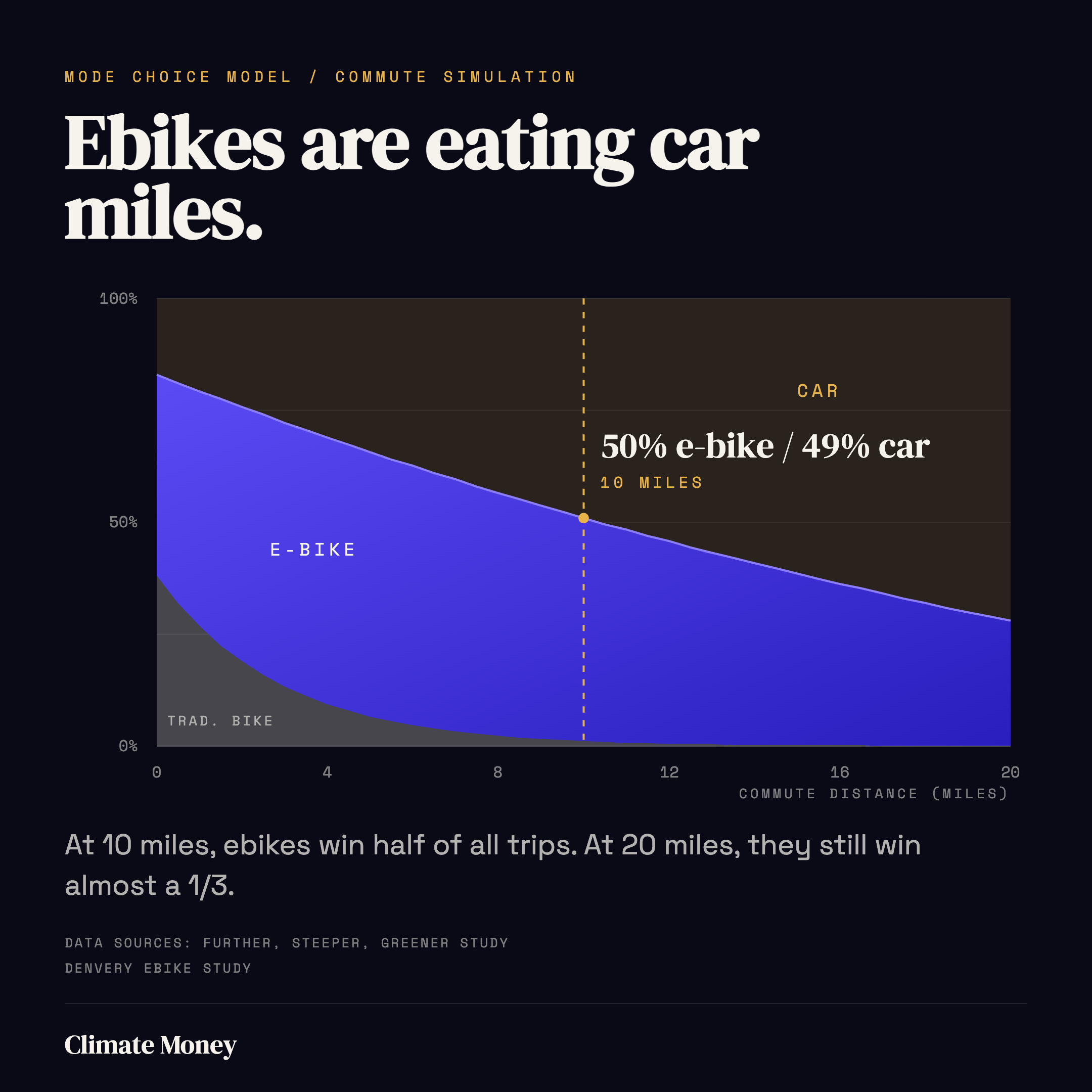
This is proven out in the data.
Recent comprehensive research analyzing over 190,000 trips found that 63.2% of the kilometers traveled by ebike would have otherwise been car trips.
43% of all individual ebike trips directly replaced a car trip, and 65% of ebike owners say that replacing car trips is their primary motivation for buying an ebike.
In separate analysis of the City of Denver’s ebike program, low income participants rode their ebikes 50% more than other participants, average 32 miles / week for utilitarian transportation rather than recreation.
In China, there are an estimated 400 million ebikes in use, with urban residents using them for 30% of all daily trips.
And in our family, we permanently tabled our plans for a second car and embraced a decidedly unsexy, upright, helmeted ride instead.
I am not some cycling badass or road warrior. I am simply a rational decision maker voting with my wallet, and it just happens to be one of the most climate-friendly choices any global consumer can make.
This is how all climate tech should be, not glamorous but practical, not premium but cheaper, not for elites but helping even the poorest in the world live a better life.
Sources:
Arning, L., & Kaths, H. (2025). Further, steeper, greener: Implications from an electric bicycle mode choice model. International Journal of Sustainable Transportation, 19(11), 979–994.
Denver’s 2022 Ebike Incentive Program, Results and Recommendations by RMI, Denver Climate Action, Sustainability & Resilience, People for Bikes, Bicycle Colorado and Ride Report
China’s bicycle ownership on the rise as low-carbon travel takes off, China Daily.
Know your EV: Embedded carbon and EVs, Drive Electric
Electric Vehicle Myths, US EPA
Electric Vehicle Outlook 2026, Bloomberg NEF
EVs Avoided the Use of 2.3 Million Barrels of Oil Per Day in 2025, Bloomberg
Electric Bicycles vs. Cars: A Comprehensive Lifecycle Carbon Footprint Analysis, MovCan
Hidden CO2 sources when producing an electric motorcycle, Vattenfall and Cake
Disclosure: I am a personal investor in Zeno.
I’m curious what monthly ebike rental service your family tried in Seattle. I’ve seen a lot of Lime bikes and scooters in neighborhoods
Love this piece, Susan! Do you have any thought (prescriptions) for moving "The West" in the direction of more 2 and three wheeled EVs? I also have to imagine that if there were small, light "city cars" that were designed for the 80% of trips, like the Fiat Topolino, that would also be a win for the climate. Most drivers don't need 300+ miles of range on most days, and something like a Topolino could get the two kids and groceries home on a blustery, rainy day for the parent who is not willing to don rain gear and a helmet.
One thing I always come back to is the idea of charging registration fees based on GVW and wheelbase to send a price signal. Eliminating free street parking is another, but it has to be done much more widely and uniformly than in a city like Seattle where the price to park can vary by a factor of 5 from one block to the next (or from free to paid) creating a slot machine effect where people always thing they will find cheap parking.